
A full cross stitch fills a whole square, which is why curves can look like little staircases. Fractional stitches fill part of a square and round those steps off. The three-quarter stitch is the one you will meet most, but half and quarter stitches show up too. None of them is hard once you see how they are built.
The three fractional stitches
| Stitch | What it is | Used for |
|---|---|---|
| Half stitch | One diagonal leg, corner to corner | Soft shading, skies, light backgrounds |
| Quarter stitch | A short leg from one corner to the center | Tiny details, and the second color in a shared square |
| Three-quarter stitch | A quarter stitch plus one long diagonal leg | Smooth curves and edges: the most common one |
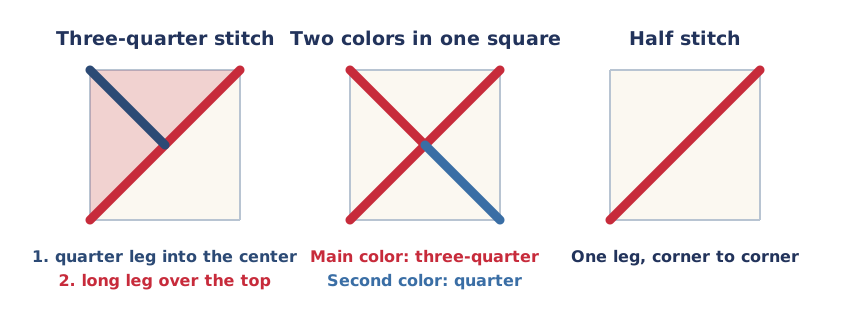
How to spot them on a chart
A square with only one triangle filled is a three-quarter stitch: the filled triangle shows which half of the square to cover. A small symbol tucked into one corner is a quarter stitch. Half stitches usually have their own line in the key, often labeled “half stitch”, or they are drawn as a single diagonal line.
When two symbols share one square, split diagonally, the square holds two colors: a three-quarter stitch in one and a quarter stitch in the other.
How to stitch a three-quarter stitch
- Look at the chart and find the filled triangle. Its long edge is the diagonal you will stitch; its third corner is where the short leg starts.
- Make the quarter leg: come up at that third corner and go down in the center of the square.
- Make the long leg: come up at one end of the diagonal and go down at the other, passing over the quarter leg in the middle.
Some stitchers make the long leg first and the quarter leg second. Both are fine. Pick one order and use it every time, so all your three-quarter stitches look alike.
The center of the square on Aida
On evenweave stitched over two, there is already a hole in the middle of every stitch. On Aida there is not, so the quarter leg has to go through the middle of the woven block.
- Push the needle straight down through the center with a firm, steady press. It goes through more easily than you expect.
- Poke the hole first from the front with the tip of the needle, then bring the thread through.
- If you stitch lots of fractionals, a fine, sharp embroidery needle makes the center much easier than a blunt tapestry needle.
Two colors in one square
Stitch the three-quarter stitch in the color that should stand out, usually the main subject, such as a cat against the sky. Then fill the other triangle with a quarter stitch in the second color. The two short legs meet in the center.
How to stitch a half stitch
Come up at one corner and go down at the opposite corner, just like the first leg of a normal cross. Keep all half stitches in an area slanting the same way unless the chart tells you otherwise. Because a half stitch covers less fabric, some patterns ask for an extra strand to fill it out.
Tips for neat fractionals
- Stitch fractionals together with the full crosses of the same color, not at the end.
- Keep the same tension as your full stitches. A tight quarter leg can sink into the center and disappear.
- If a pattern is full of fractionals and Aida feels like a fight, try evenweave for that project.
🎓 Stitch Club members practice smooth curves on a pattern made for it and earn the Fraction Master badge. See Week 5 of Cross Stitch School
Frequently asked questions
What is a three-quarter stitch?
A quarter stitch from one corner into the center of the square, plus one long diagonal leg. Together they fill half of the square as a triangle.
How do you do a three-quarter stitch on Aida?
Make the short leg from the outer corner and push the needle down through the middle of the Aida block, then make the long diagonal leg over it.
What is the difference between a half stitch and a three-quarter stitch?
A half stitch is a single diagonal leg. A three-quarter stitch adds a short leg into the center, so it fills a triangle instead of a thin line.
Do I have to stitch the fractional stitches?
For your own projects you can turn a few into full stitches where they hardly show. Keep them where they shape a face, an eye or a visible edge.