
Backstitch is the thin line that finishes a design: the outline of a leaf, the whiskers on a cat, the words on a sampler. French knots are the tiny raised dots for eyes, flower centers and snow. A cross stitch piece can look a little blurry until these go in, and then it suddenly looks done.
Backstitch on a chart
Backstitch is drawn as colored lines along the edges of the squares, with its own short list in the key (often called the backstitch key). It is nearly always stitched after the cross stitches, on top of them, and usually with one strand so the line stays crisp.
How to backstitch, step by step
- Bring the needle up one stitch length ahead of where the line starts.
- Go down back at the very start of the line. That is your first stitch.
- Come up one stitch length ahead of the end of that stitch.
- Go down back into the hole at the end of the previous stitch, so the stitches share holes and the line has no gaps.
- Repeat along the line.
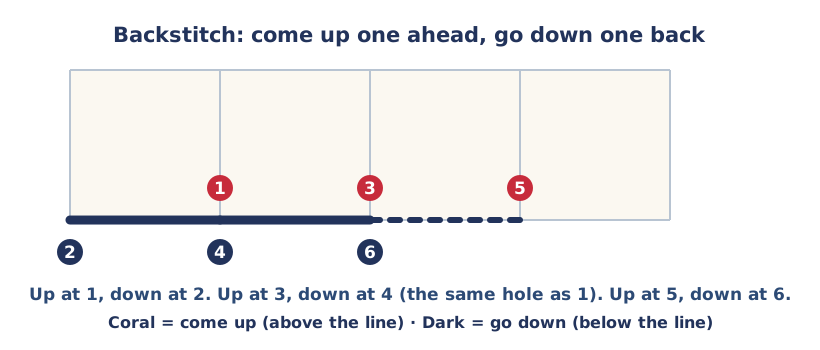
Each backstitch usually covers one side of a square. A pattern may show longer stitches over two or three squares for straight lines; follow the chart.
Which thread and color?
- Strands: one strand on 14-count and finer fabric; two on 11-count, or where the pattern asks for a bold line.
- Length: cut it shorter than usual, about 15 inches (38 cm). One strand wears thin quickly.
- Color: black (DMC 310) is classic but can look harsh around pale colors. A very dark gray such as DMC 3799, or a deep shade of the color inside the outline, often looks softer and more natural.
Tips for clean outlines
- Start and finish by sliding the thread under the backs of nearby cross stitches. No knots.
- Do not carry the thread across bare fabric at the back. It shows through on the front.
- Plan long lines before you start, so you finish near the next line instead of far away.
- Around curves, follow the chart exactly. Shorter stitches make smoother curves.
How to make a French knot
- Bring the needle up where the knot belongs.
- Hold the thread taut with your other hand and wrap it around the needle once or twice.
- Still holding the thread taut, put the needle back down right beside where it came up, but not in the same hole. On Aida, pierce the fabric just next to the hole.
- Slide the wraps down against the fabric and pull the needle through slowly, keeping your thumb on the wraps until the knot settles.
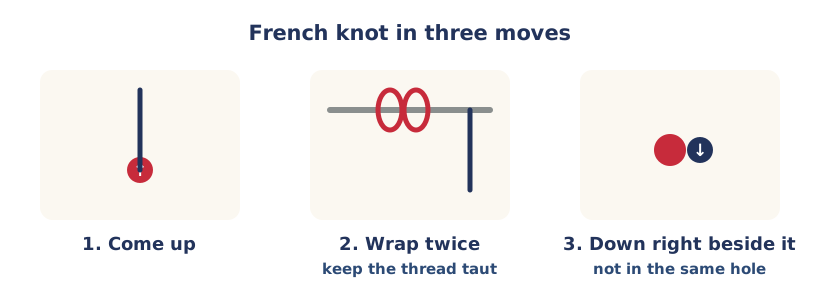
Most French knots use two strands. On a chart they appear as a dot or a small circle, often where grid lines cross.
When French knots go wrong
| Problem | Fix |
|---|---|
| The knot pulls through to the back | You went down in the same hole. Go down just beside it. |
| Loose, loopy knot | Keep the thread taut until the needle is all the way through. |
| Knot too small | Use one more strand, or add one more wrap. More than two or three wraps tends to look messy. |
| Knot sits off to one side | Go down closer to where you came up, and hold the wraps straight as you pull. |
🎓 Stitch Club members add outlines and knots to their own practice piece and earn the Outline Artist badge. See Week 6 of Cross Stitch School
Frequently asked questions
How many strands for backstitch in cross stitch?
Usually one strand on 14-count Aida and finer fabric, and two strands on 11-count or where the pattern asks for a bold line.
Do you backstitch before or after cross stitch?
After. Backstitch sits on top of the cross stitches, so it goes in once the crosses around it are done.
How many wraps for a French knot?
One or two. For a bigger knot, use an extra strand rather than many wraps.
Why does my French knot keep disappearing?
The needle went back down through the same hole it came up from. Go down just beside it instead.