
Welcome to Cross Stitch School! This first lesson answers the big question, what cross stitch actually is, and shows you the few simple supplies you need. By the end you will have your fabric ready in a hoop for next week’s first stitches.
What is cross stitch?
Cross stitch is a type of embroidery where you sew small X-shaped stitches onto a fabric that has a regular grid of holes. Each X fills one square of the grid, and a chart (the pattern) tells you which color goes in which square. Square by square, the Xs build up a picture, a bit like pixels on a screen.
There are two kinds:
- Counted cross stitch: the fabric is blank and you follow a printed chart, counting squares. This is what most patterns (including ours) are, and what this School teaches.
- Stamped cross stitch: the design is printed on the fabric and you stitch over it. Easier to start, but you are limited to the kits you can buy.
Cross stitch is one of the easiest kinds of embroidery to learn, because there is really only one stitch to master. If you can count to ten and thread a needle, you can do it.
The six supplies you need
1. Aida fabric
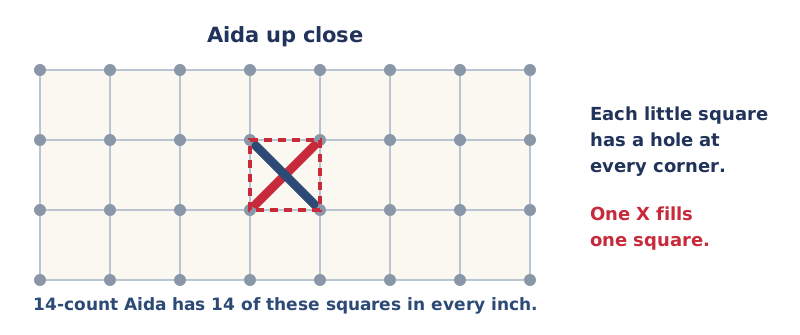
Aida is a cotton fabric woven into little squares with clear holes at each corner, so it is easy to see where your needle goes. It comes in different “counts”: the number of squares per inch. For your first projects choose 14-count white or cream Aida. The squares are big enough to see comfortably, and most patterns are designed for it. (Week 4 explains counts in detail.)
2. Embroidery floss
Cross stitch uses stranded cotton, usually called floss. Each length is made of six thin strands twisted together, and you separate them to stitch with just a few at a time (two strands on 14-count Aida). Patterns list colors by number from a brand, most often DMC, so you can buy exactly the right shades. Floss is sold in small bundles called skeins, about 8.7 yards (8 m) each, and one skein of each color is enough for a small project.
For next week’s practice you need just two colors: DMC 3712 (salmon pink) and DMC 3363 (green). Any two colors you like will work too.
3. A tapestry needle
Tapestry needles have a blunt tip and a large eye. The blunt tip slips through the holes in Aida without splitting the fabric or your thread. For 14-count Aida use a size 24 needle (size 22 for 11-count, size 26 for 16 and 18-count).
4. An embroidery hoop
A hoop is two rings that hold your fabric tight like a drum, which makes stitches neat and even. A 5 or 6 inch (12-15 cm) wooden or plastic hoop is perfect for small projects. Some stitchers work without a hoop, but it is much easier to learn with one.
5. Small sharp scissors
Small embroidery scissors let you snip thread close to the fabric. Keep them just for thread so they stay sharp.
6. A pattern
The pattern (or chart) is a grid where each square shows a symbol or color, plus a key that tells you which floss each symbol means. Start with something small and simple, under 50 × 50 stitches and with only a few colors. Each week of this School comes with a practice pattern made for that lesson.
Nice to have (not needed yet)
- Floss bobbins or a small box to keep colors tidy
- A needle minder (a small magnet that holds your needle)
- A highlighter to mark finished areas on a printed chart
- Good light, ideally a daylight lamp
Kit or separate supplies?
A kit includes fabric, pre-sorted floss, a needle and a pattern, so it is an easy way to try cross stitch. Buying separately costs a little more at the start, but you can then stitch any pattern you like, and one hoop, needle pack and pair of scissors will last for years. Both are fine; if you already love a pattern, just buy what it lists.
Getting your fabric ready
- Cut your fabric bigger than the design: add about 3 inches (7-8 cm) on every side, so there is room for the hoop and for framing later.
- Stop the edges fraying with a strip of masking tape folded over each edge, or a quick zigzag stitch on a sewing machine.
- Find the center: fold the fabric in half one way, then the other, and pinch the corner. Where the folds cross is the middle. Most patterns start from the center, so the design ends up nicely placed.
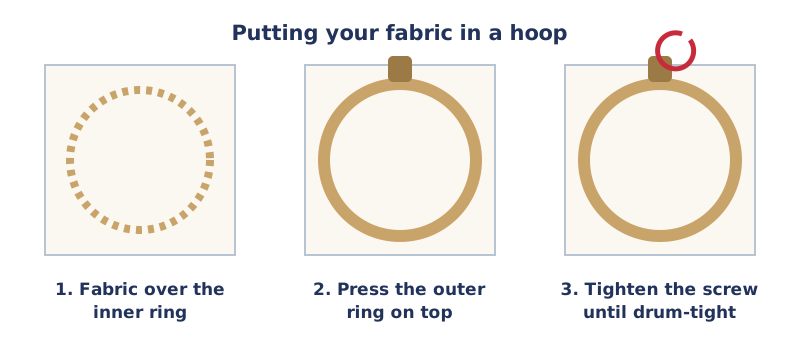
- Put it in the hoop: loosen the screw, lay the fabric over the inner ring with the center in the middle, press the outer ring on top, and tighten until the fabric is firm and flat, with no wrinkles. When you finish stitching for the day, take the fabric out of the hoop, so it does not leave a ring-shaped crease.
Watch: cross stitch supplies for beginners
Video by: Notorious Needle
In the video, Sarah calls a hoop an extra. It is not strictly needed, but we suggest one while you learn: it keeps your stitches even.
This week’s challenge
Week 1 challenge · Badge: Ready to Stitch
Get ready to stitch
- Gather the six supplies from this lesson (use the printable checklist). For floss, get DMC 3712 and DMC 3363 for next week, or any two colors you like.
- Cut a piece of 14-count Aida about 8 × 8 inches (20 × 20 cm) and tape the edges.
- Find the center and put the fabric in your hoop, drum-tight.
- Bonus: separate one length of floss into single strands, so you are ready for next week.
📄 Supplies checklist (PDF) is free with an account. Create a free account
Quick answers
What is the best fabric for cross stitch beginners?
14-count Aida in white or cream. The holes are easy to see and most beginner patterns are made for it.
What size needle do I need for cross stitch?
A blunt tapestry needle: size 24 for 14-count Aida, size 22 for 11-count and size 26 for 16 or 18-count.
Do I need a hoop for cross stitch?
Not strictly, but a hoop keeps the fabric tight so your stitches come out even. It makes learning much easier.
What is the difference between cross stitch and embroidery?
Cross stitch is one kind of embroidery. It uses only X-shaped stitches on grid fabric, while embroidery in general uses many different stitches on plain fabric. Read the full comparison.